
The Complete Guide to Honing Machines: Precision Manufacturing Technology for 2025
What is a Honing Machine and Why Does Precision Matter?
In modern manufacturing, achieving micron-level accuracy isn’t just a goal—it’s a requirement. A honing machine is a specialized precision tool designed to finish cylindrical internal surfaces to exacting tolerances, creating the smooth, accurate bore dimensions critical for automotive engines, hydraulic cylinders, aerospace components, and industrial equipment.
Unlike conventional grinding or boring, honing uses abrasive stones in a rotating, reciprocating motion to remove microscopic amounts of material. This process creates the distinctive crosshatch pattern that optimizes oil retention, reduces friction, and ensures dimensional accuracy that other finishing methods simply cannot achieve.
How Honing Machines Work: The Technology Behind Precision
The Honing Process Explained
Honing machines operate through a sophisticated combination of three simultaneous motions:
- Rotation – The honing tool spins at controlled speeds
- Reciprocation – The tool moves up and down within the bore
- Expansion – Abrasive stones press outward against the workpiece
This triple-action process removes material in a controlled, consistent manner while the flood of cutting fluid removes debris and prevents heat buildup. The result? Surface finishes measured in microinches and dimensional tolerances held to within 0.0001 inches.
Types of Honing Machines
Modern honing machine manufacturers offer several configurations to meet diverse production needs:
Single-Spindle Honing Machines: Ideal for job shops and prototype work, these machines handle one workpiece at a time with maximum flexibility for different bore sizes and lengths.
Multi-Spindle Honing Machines: Designed for high-volume production, these systems process multiple parts simultaneously, dramatically reducing cycle times in automotive and industrial manufacturing.
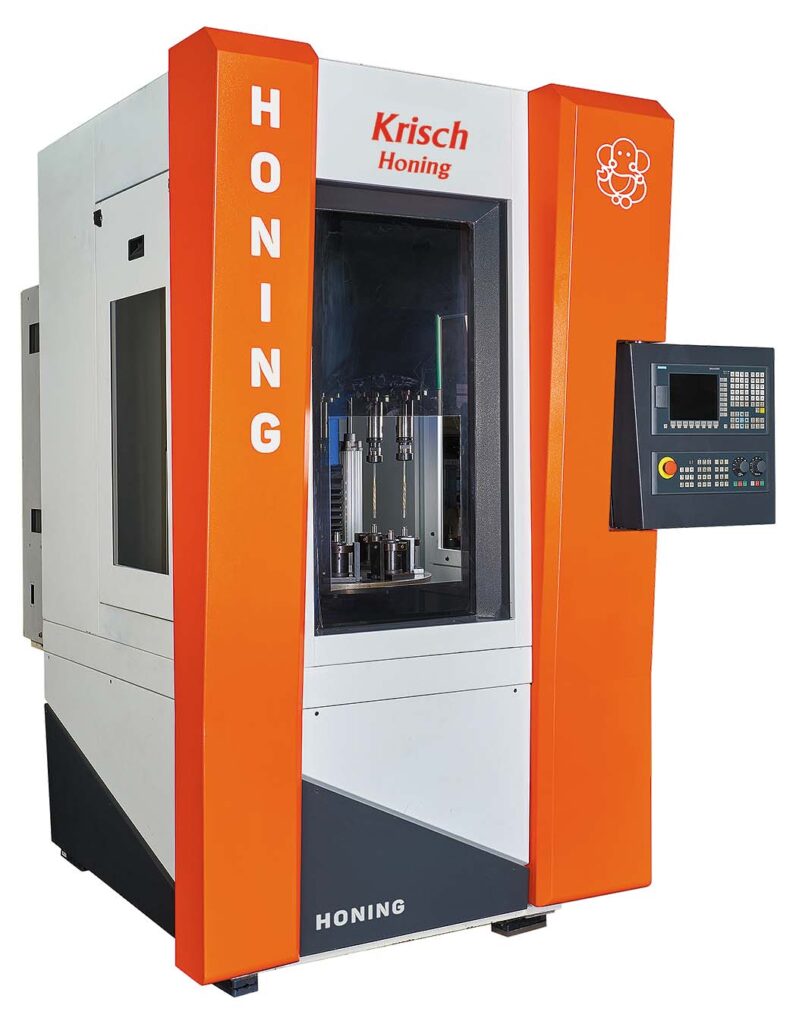
CNC Progressive Honing Machines: The latest advancement in honing technology, CNC systems provide automated tool expansion, position control, and process monitoring. Krishna Enterprise’s CNC progressive honing machines combine computer precision with mechanical reliability for consistent, repeatable results.
Vertical vs. Horizontal Honing Machines: Configuration depends on workpiece size, production volume, and floor space considerations.
Key Industries Using Honing Machines
Automotive Manufacturing
Engine cylinder bores represent the most common honing application. The crosshatch pattern created during honing allows engine rings to seat properly while providing channels for oil distribution. Major automotive manufacturers including Bosch and Godrej rely on precision honing for:
- Engine cylinder blocks and liners
- Connecting rods
- Transmission components
- Fuel injection parts
- Hydraulic cylinders
Aerospace and Defense
Aircraft hydraulic systems, landing gear components, and turbine engine parts demand the exceptional surface finishes and tight tolerances that only honing can provide. Aerospace-grade honing achieves surface finishes below 4 microinches Ra.
Industrial Hydraulics and Pneumatics
Hydraulic cylinders, pneumatic actuators, and servo valves require leak-free performance under extreme pressures. Honing creates the bore geometry necessary for proper seal function and extended component life.
Medical Device Manufacturing
Surgical instruments, implantable devices, and precision medical equipment increasingly utilize honed components where biocompatibility meets mechanical precision.
What Makes a Quality Honing Machine Manufacturer?
In-House R&D and Engineering Capabilities
Leading honing machine manufacturers invest heavily in research and development. Krishna Enterprise’s dedicated R&D team continuously innovates to address evolving manufacturing challenges, from new materials to tighter tolerances to faster cycle times.
Manufacturing Quality and Precision
The irony isn’t lost: honing machines must themselves be manufactured to exacting standards. Quality indicators include:
- Heavy-duty cast iron construction for vibration damping
- Precision ground spindles and bearings
- Advanced servo motor controls
- Robust tooling systems
- Comprehensive quality testing protocols
Customer-Centric Custom Solutions
Every manufacturing operation has unique requirements. Whether you need to hone small diameter fuel injector bores or large hydraulic cylinders, the right manufacturer will engineer custom solutions tailored to your specifications, production volumes, and quality requirements.
Technical Specifications to Consider When Selecting a Honing Machine
Critical Performance Parameters
Bore Diameter Range: Can the machine accommodate your smallest and largest parts? Most industrial honing machines handle diameters from 25mm to 300mm, though specialized machines go much larger or smaller.
Honing Depth/Stroke Length: Verify the machine can reach the full depth of your longest bores without repositioning.
Spindle Speed and Power: Higher horsepower enables faster material removal, but controllability matters more than raw power.
Expansion Mechanism: Hydraulic, mechanical, or pneumatic expansion systems each offer advantages for different applications.
Control System: Modern CNC controls provide process monitoring, automatic compensation, and data logging for quality documentation.
Accuracy and Surface Finish Capabilities
Professional honing machines should consistently achieve:
- Cylindricity within 0.005mm
- Surface roughness from 0.1 to 1.5 Ra (micrometers)
- Straightness within 0.01mm per 100mm
- Crosshatch angles between 20-60 degrees depending on application
Honing vs. Other Finishing Processes
Honing vs. Grinding
While both are abrasive processes, internal grinding uses a rotating wheel for faster stock removal but typically achieves rougher surface finishes. Honing produces superior bore geometry and the crosshatch pattern essential for lubrication retention.
Honing vs. Boring
Boring is a cutting operation that removes large amounts of material to establish bore size. Honing follows boring as a finishing operation, removing only 0.05-0.5mm of material to achieve final size, finish, and geometry.
Honing vs. Reaming
Reaming cuts material with fluted edges, while honing uses abrasive action. Honing produces better surface finishes, tighter tolerances, and superior cylindricity compared to reaming.
The Future of Honing Technology: Industry 4.0 and Automation
Smart Manufacturing Integration
Today’s advanced honing machines integrate with manufacturing execution systems (MES), providing real-time production data, quality metrics, and predictive maintenance alerts. This Industry 4.0 connectivity enables:
- Remote monitoring and diagnostics
- Automatic process optimization
- Statistical process control integration
- Traceability for ISO/TS compliance
Automation and Robotics
Multi-spindle honing machines increasingly incorporate robotic loading/unloading systems, reducing labor costs while improving consistency. Automated measurement systems verify dimensions without operator intervention, enabling lights-out manufacturing.
Maintenance and Operational Excellence
Extending Honing Machine Lifespan
Proper maintenance ensures decades of reliable operation:
- Daily: Check coolant levels and concentration, inspect abrasive stones
- Weekly: Clean filters, verify tool expansion mechanism function
- Monthly: Calibrate measurement systems, inspect spindle bearings
- Annually: Professional service inspection, accuracy verification
Optimizing Honing Parameters
Achieving optimal results requires balancing multiple variables:
- Stone grit size and material
- Expansion pressure
- Rotational and reciprocating speeds
- Crosshatch angle
- Coolant type and flow rate
Experienced honing machine manufacturers provide application engineering support to develop optimal processes for your specific materials and requirements.
Why Choose Krishna Enterprise as Your Honing Machine Manufacturer
With over 10 years of manufacturing excellence, Krishna Enterprise has established itself as a trusted honing machine manufacturer serving global manufacturing operations. Our commitment to quality manifests in:
Proven Track Record: Our machines operate in facilities of leading manufacturers including Godrej and Bosch, producing millions of precision components annually.
Technical Innovation: Our in-house R&D capabilities enable us to develop advanced CNC progressive, single-pass, multi-spindle honing machines that meet evolving industry demands.
Micron-Level Precision: Every machine undergoes rigorous testing to ensure it delivers the accuracy your operations require.
Custom Engineering: We don’t believe in one-size-fits-all solutions. Our engineering team works directly with you to configure machines for your specific applications.
Comprehensive Support: From installation and training to ongoing technical support, we partner with our customers for long-term success.
Making the Right Honing Machine Investment
Selecting a honing machine represents a significant capital investment. Consider these factors:
Total Cost of Ownership: Initial price is just one component. Factor in energy consumption, tooling costs, maintenance requirements, and production efficiency.
Scalability: Will the machine accommodate future part families or volume increases?
Service and Support: What level of technical assistance does the manufacturer provide? Are spare parts readily available?
Training and Documentation: Comprehensive operator training and maintenance documentation are essential for maximizing your investment.
Conclusion: Precision Manufacturing Starts with the Right Partner
In an era where manufacturing tolerances continue to tighten and quality expectations continue to rise, honing machines have become indispensable tools across automotive, aerospace, hydraulics, and industrial manufacturing sectors.
Choosing the right honing machine manufacturer means partnering with a company that understands not just the technology, but your specific application challenges and business objectives.
At Krishna Enterprise, we’ve built our reputation on delivering precision honing solutions that help manufacturers achieve their quality, productivity, and profitability goals. Whether you’re establishing a new production line or upgrading existing capabilities, our team of engineers is ready to help you select and configure the ideal honing machine for your operation.
Ready to discuss your honing machine requirements? Contact our technical team today to explore how our CNC progressive, multi-spindle honing machines can enhance your manufacturing capabilities.
Krishna Enterprise – Precision Honing Solutions for Global Manufacturing. Serving industries worldwide with advanced CNC progressive, single-pass, multi-spindle honing machines manufactured to the highest quality standards.

Founded in 1994 by Mr. Ajeet Samani, Krishna Enterprise began as a small workshop with a vision to provide precision honing solutions to the manufacturing industry. Over the past two decades, we have grown into a respected name in the honing machine manufacturing sector, serving clients across India and internationally.
